How Engaged Are Your Customers?By Megan Burns November 2008 Adobe commissioned Forrester to conduct tis study and author the report. It is available for download here (Adobe Engagement Site and the PDF report). Engagement is a key business imperative, but actually measuring the business impact of technology-driven engaging experiences is no simple task. Two commissioned studies conducted by Forrester Consulting on behalf of Adobe analyze how companies are creating and measuring engaging online experiences. In this report, Forrester recommends a new methodology for tying engagement metrics to business metrics. |
A CMO's Guide To Corporate Social Responsibilityby Brian Haven July 31, 2008 People increasingly expect firms to behave in a socially responsible manner, but many companies are only beginning to take action. Corporate social responsibility (CSR) is not simply a passing fad; it's a growing trend that CMOs need to acknowledge and that will affect every part of the organization. As their firms assess which CSR initiatives to take, marketing leaders should take the lead in understanding the customers' needs and voicing them inside the firm. With more consumers willing to pay more for environmentally friendly products and fair trade, CMOs will find that CSR can add to the profitability of the business. |
Building An Effective Green Marketing StrategyThis is the first document in the "Green Marketing" series. July 31, 2008 Organizations are under pressure from consumers, shareholders, and government bodies to develop green strategies. However, many marketers are jumping on the green bandwagon and committing common green marketing mistakes. To avoid these mistakes and build effective green strategies, marketers should focus on seven key actions: 1) assessing current impact and attitudes toward green; 2) listening to consumers about their wants, needs, and ideas for better sustainability; 3) aligning the green strategy with the organization, brand, and consumer values; 4) committing to environmental goals and making significant changes; 5) partnering with outside organizations for credibility, expertise, and joint solutions; 6) educating stakeholders on the issues and benefits of green products; and 7) engaging stakeholders in open dialogue and activities to facilitate behavior change. |
Case Study: Intel Uses Partnerships For Green StrategyThis is the fourth document in the "Green Marketing" series. July 31, 2008 Intel actively participates in efforts to improve the sustainability of all aspects of the product life cycle and value chain, from the materials it sources to the end-of-life reuse and recycling efforts. To push these efforts forward, Intel uses the support of industry partners, community groups, employees, and government agencies. As a result, Intel creates a more sustainable product life cycle, while helping its end customers see the benefits of greater energy efficiency — positioning Intel in first place on the 2007 "100 Best Corporate Citizens" list published by CRO Magazine. |
Case Study: Herman Miller Shows That Sustainability And Profits Go Hand-In-HandThis is the third document in the "Green Marketing" series. July 31, 2008 Herman Miller, designer and manufacturer of furnishings and other building interior systems and technologies for the office, healthcare, education and home, began to incorporate sustainability into its business practices in the early 1950s. Since then, Herman Miller has committed to audacious environmental goals and transformed its organization, design and manufacturing processes, marketing materials, and relationships with customers. As a result, Herman Miller has seen significant cost savings from energy reduction and more efficient manufacturing processes as well as progress toward its goal of zero emissions by 2020. |
Case Study: Vancity Engages Stakeholders In Green EffortsThis is the second document in the "Green Marketing" series. July 31, 2008 As a small credit union in the Vancouver area, Vancity was founded on principles of community and has won numerous awards for its work around sustainability and climate change. With a re-branding effort that included an opportunity to better highlight its sustainability efforts, Vancity actively engages members and prospective members through new social media channels, member forums, unique brand campaigns, educational activities, and numerous opportunities for stakeholder feedback. As a result, brand preference went up by 30% and Vancity announced that it became carbon-neutral at the end of 2007, two years ahead of plan. |
Measuring EngagementFour Steps To Making Engagement Measurement A Reality June 10, 2008 The metrics marketers use today fail to capture the supercharged social behaviors and intimate relationships people have with brands. With the four I's of engagement: involvement, interaction, intimacy, and influence — marketers obtain a framework to decipher this complexity. To measure engagement, marketers need to take four critical steps: define, audit, assess, and prioritize the metrics that are appropriate for their customer buying processes. |
Disruption Looms For Financial ServicesSocial Media Entrants Show Marketers A New Way For Brand Differentiation May 6, 2008 A new crop of financial services startups use social media tools like social lending and re-envisioned money management to enrich the experience around money management for consumers. As the quality of online financial services drives customer loyalty and advocacy, and customers of the major US banks are very active in social networks, marketers of financial institutions have a great opportunity to add community services to their portfolios. They should start with researching the needs and drivers of their target customers with ethnographic research and studying the adoption of services from the new entrants. |
Five Tools And Technologies To Measure EngagementThis is the first document in the "Measuring Customer Engagement" series. April 22, 2008 Measuring engagement is no simple task: It requires a cross-channel, data-intensive approach that strains today's measurement processes and the underlying technology that supports them. Furthermore, marketers attempting to measure engagement without the proper tools often find themselves lacking the infrastructure to make engagement an ongoing effort. Forrester has defined five key tools and technologies that marketers need to put in place an engagement-driven measurement methodology across their enterprise. |
The YouTube Viewer's Ad And Social Media Habitsby Brian Haven, January 7, 2008 Ten percent of US online adults visit YouTube at least weekly. These online video viewers are strong WOM-centric consumers, which makes them an attractive audience for marketers. |
The Forrester Wave™: Interactive Marketing Agencies, Q4 2007OgilvyInteractive, Avenue A | Razorfish, Sapient, And Digitas Lead December 4, 2007 Forrester's evaluation of leading interactive marketing agencies across 52 criteria revealed a market adept at handling today's digital campaigns but lacking the thought leadership to drive more comprehensive brand strategies. In the current environment, OgilvyInteractive, Avenue A | Razorfish, Sapient, and Digitas lead because of their breadth of experience with interactive marketing campaigns utilizing many different channels (email, search, display ads, and emerging channels), as well as strong measurement and analytics capabilities. Strong Performers include VML, based on its strategic guidance, and Critical Mass and imc2, with their interactive skills rooted in Web site design. All of the agencies in this evaluation still have a lot of work ahead of them to prove that they have the acumen, vision, and road map to lead broader cross-channel marketing and brand strategies. |
Marketing's New Key Metric: EngagementMarketers Must Measure Involvement, Interaction, Intimacy, And Influence August 8, 2007 The marketing funnel is a broken metaphor that overlooks the complexity social media introduces into the buying process. As consumers' trust in traditional media diminishes, marketers need a new approach. We propose a new metric, engagement, that includes four components: involvement, interaction, intimacy, and influence. Each of these is built from data collected from online and offline data sources. Using engagement, you get a more holistic appreciation of your customers' actions, recognizing that value comes not just from transactions but also from actions people take to influence others. Once engagement takes hold of marketing, marketing messages will become conversations, and dollars will shift from media buying to customer understanding. |
Youth Podcast User Profileby Brian Haven, August 6, 2007 This data chart is a profile of youth podcast users, including current usage, current topics, and future interests. |
Youth Online Video And Advertising Profileby Brian Haven, August 6, 2007 This data chart is a profile of online video users, including their demographics, psychographics, what sites they visit, and attitudinal statements around online ads. |
A Second Life For Marketers?Virtual Worlds Aren't New Channels, They're New Markets May 1, 2007 Virtual worlds have recently emerged as a new opportunity for users to interact and marketers to communicate. Second Life, one of the most widely known worlds, experienced an influx of marketers in 2006 looking for new ways to engage with potential customers. The key benefit so far: public relations. For the future, marketers should consider virtual worlds not as new channels, but instead as entirely new markets. But for now, virtual worlds aren't quite ready to meet the demands and expectations of marketers. [— url —] |
Interactive Marketing Channels To Watch In 2007Marketers Still Aren't Comfortable With Emerging Interactive Channels March 27, 2007 Email and search marketing eclipse online display ads as the most prominent elements in the interactive marketing mix, while social media — like blogs, podcasts, RSS, social networks, and online video — are strong up-and-comers. But mobile and game marketing are relatively ignored. Why? Marketers won't adopt until they see proof that emerging channels work. Our advice? Start adopting now to keep up with your customers who already actively use emerging technologies. Advanced online ad targeting, RSS, and blogs provide the easiest entry points. [— url —] |
Leveraging User-Generated ContentMarketers Must Find Ways To Let Customers Help Drive The Brand January 25, 2007 User-generated content (UGC) is a hot topic in the press. With more than one-quarter of online consumers submitting a rating or review of a product or service or contributing to a discussion board, the fact that consumers are turning to each other is not just a fad any more. A few forward-thinking brands are beginning to use UGC to engage with customers. To overcome initial fears, companies need to realize that successfully opening up to customers isn't that different from the risks associated with doing business every day. To determine the appropriate UGC strategy, companies must observe where UGC about their brands lives today, continually track conversations in UGC, and participate in existing communities before deciding if this is an activity that they should enable on their own sites. [— url —] |
Making Podcasts Work For Your BrandGenerate Content Based On Brand Attributes, Not Products January 24, 2007 Podcasting has seen mild adoption growth in the past year, but it still hasn't experienced the popularity explosion blogs have seen. However, this doesn't mean that marketers shouldn't offer podcasts to their customers. Additionally, using podcasts for internal purposes is a great way to test the waters before you start creating content for customers. Before getting involved, it's important to understand how the podcasting world works, determine if it's right for your audience, and choose the right type of podcast to create. Once you have a clear understanding of these issues, you can focus on the proper techniques for developing a successful podcast. [— url —] |
Google-YouTube: The Value Of Social ComputingBut This $1.65 Billion Purchase Could Run Afoul Of Copyright Problems October 10, 2006 On October 9, 2006, Google agreed to buy user-generated video site YouTube for $1.65 billion in stock. This is a massive demonstration of the power of social computing: Google already has the No. 3 video site, but now it will own a networking platform that makes video stickier — and better for advertisers. To make this huge purchase worth it, Google must move rapidly to: 1) address the problem of users uploading copyrighted content; 2) encourage marketers to think beyond traditional video advertisements; and 3) maintain YouTube's excellent video selection and viewing experience. [— url —] |
Should Your Brand Use Online Video?Advertisers Must Think Like Content Providers To Engage Video Viewers October 3, 2006 With more than half of adults (53% of consumers 18 and older) stating that they view online video, we're witnessing the early signs of mainstream adoption of Internet video. Given that Gen Xers and Gen Yers view video more often than older generations, this sought-after audience is a prime target for video advertising. However, with diminishing effectiveness of standard online ads, marketers need to be more creative with their messages and targeting. To leverage online video in order to target customers effectively, marketers must think like content providers by creating entertaining video, not just placing ads. Some retail brands, such as Amazon, Borders, Best Buy, and Gap, actually have significant numbers of their customers viewing online video — making them a prime target. [— url —] |
More Consumers Look To The Net For ContentAlmost Half Of Online Consumers Use Less Offline Media September 11, 2006 Although consumer trust in traditional media sources like TV, newspapers, radio, and magazines rebounded in 2005 from a low in 2004, online consumers are turning more and more to the Internet for content like weather, general news, and sports news. The Internet also rules when consumers seek archived news, business or reference information, or adult entertainment, and among more tenured and younger consumers who grew up with the Internet's wealth of content at their fingertips. [— url —] |
Gen Yers' Big Media Appetites Focus On The WebAn Excerpt From "The State Of Consumers And Technology: Benchmark 2006" September 11, 2006 Media consumption varies widely by generation. Young consumers spend less time with TV or print and more time online and with user-generated content. Gen Yers (18- to 26-year-olds) tell us that they spend eight hours more online per week than Seniors (62 years old and older), while Seniors spend eight hours more per week watching TV and reading newspapers. Social media use continues to grow, particularly among brands with a youthful following. But even brands with older audiences like The Wall Street Journal are seeing one-third of their users consuming social media. [— url —] |
The Forrester Wave™: Rich Media Content Delivery, Q2 2006Akamai Leads In Our Services Evaluation June 9, 2006 Forrester evaluated leading rich media content delivery vendors across 70 criteria and found that Akamai Technologies' expansive network and media experience established it as a leader in the category. However, robust reporting and delivery management capabilities make Nine Systems and VitalStream compelling options, and experience derived from a large client base demonstrates Limelight's strength. Companies expanding into rich media should give special attention to media and entertainment experience and flexibility with emerging distribution options like podcasting, mobile, and peer-to-peer (P2P) when selecting a content delivery network (CDN) partner. [— url —] |
Akamai Technologies Leads In Rich Media Content DeliveryThe Forrester Wave™ Vendor Summary, Q2 2006 June 9, 2006 As one of the original content delivery networks (CDNs), Akamai Technologies possesses a broad infrastructure with global reach and a client list that includes Apple's iTunes Music Store, NBC, and Starz Entertainment Group's Vongo. Akamai lacks the tools that are needed by media companies to manage and monitor content, opting for integration with third-party services to fill the gap. But its technical, financial, and human resources afford it the capability to implement practically any solution that a client needs. [— url —] |
Nine Systems Leverages Other CDNs For Rich Media Content DeliveryThe Forrester Wave™ Vendor Summary, Q2 2006 June 9, 2006 Nine Systems offers an impressive suite of tools for monetizing, managing, securing, and monitoring content. It also possesses special capabilities in supporting streaming of live events and is 100% focused on the media industry. Nine Systems leverages other content delivery networks (CDNs) for half of its content delivery — an approach that can be considered an advantage in some cases, but diminishes its hands-on experience in other cases. Its Stream OS tool includes management functions for ad serving, digital rights management (DRM), live events, reporting, and commerce. Clients include CinemaNow, TWI Interactive, and Universal Music Group. [— url —] |
VitalStream Excels In Streaming Services For Rich Media Content DeliveryThe Forrester Wave™ Vendor Summary, Q2 2006 June 9, 2006 VitalStream provides a robust suite of content management tools for customized reports with deep granularity of data, and one of the longest running offerings of Flash video. While it boasts a large client base (Comcast, The Wall Street Journal Online, and Walt Disney Pictures), it lacks an international network presence and experience with downloadable media. [— url —] |
Limelight Networks Offers Low-Cost Rich Media Content DeliveryThe Forrester Wave™ Vendor Summary, Q2 2006 June 9, 2006 Unlike most other vendors, Limelight Networks delivers a balanced mix of streaming and downloadable media. It focuses more of its effort on the core delivery of content and less on reporting and content management tools, relying on integration with third-party services. Limelight's clients include Akimbo, Facebook, and MSNBC. Often referred to as the low-cost provider, its financial health, client experience, and network capabilities make Limelight a worthy option for consideration. [— url —] |
Kontiki Offers A P2P Solution For Rich Media Content DeliveryThe Forrester Wave™ Vendor Summary, Q2 2006 June 9, 2006 Kontiki offers an alternative solution to the traditional content delivery network (CDN) — a peer-to-peer (P2P) architecture — which is best suited for long-form downloadable content today. Kontiki offers strong reporting and content management capabilities and its architecture can reduce bandwidth costs by up to 50%. However, customers are required to install an application on their personal computers and contribute to hosting files. Kontiki's client base is small but high in stature, including the AOL, BBC, and BSkyB. [— url —] |
SAVVIS Brings A Large Web-Caching Network To Rich Media Content DeliveryThe Forrester Wave™ Vendor Summary, Q2 2006 June 9, 2006 SAVVIS comes to the content delivery space with extensive experience in Web caching and recently added content delivery network (CDN) services through an acquisition of Cable & Wireless America. It has a large global infrastructure to leverage as it continues to integrate and enhance its CDN capabilities. SAVVIS has limited reporting capabilities, a small client base, and little experience with streaming media, but as a public company, it has strong financial resources and is dedicated to expanding its existing CDN services. [— url —] |
Warner Initiates The Swarm To P2POther Media Companies Will Find That Working With BitTorrent Makes Sense May 10, 2006 Warner Bros. Entertainment has announced that it will make legal video content available for sale as downloads through the BitTorrent peer-to-peer (P2P) publishing platform — a platform known mostly for pirate content until now. By this summer, Warner Bros. intends to make available recent releases such as Harry Potter and the Goblet of Fire, older titles such as The Matrix, and TV programs such as Babylon 5 in conjunction with the release of the same content on DVD. We expect media companies, broadband operators, and OS vendors like Apple to take advantage of P2P solutions eventually. Content delivery networks (CDNs) like Akamai will remain important partners in rich media content delivery, but they will have to address the growing costs associated with distributing content from central locations. [— url —] |
User-Generated Content Ambushes The Media BizUsage Is High, But Trust In Peers Varies Widely Among Youth And Adults April 7, 2006 Social Computing activities — blogging, podcasting, online message posting — are producing a variety of content popular with online users. Three-fourths of online adults, and more than 90% of online youth, are tapping their peers for content of all types on the Web. Adult consumers remain skeptical of content generated by other users and say that their levels of confidence in peer-generated content are decreasing. Youth, on the other hand, are more convinced of their peers' trustworthiness and say that their confidence in some forms of content is increasing. [— url —] |
Consumer Trust In Media Rebounds In 2005by Brian Haven April 6, 2006 Adult consumers' trust in traditional media — newspapers, radio, magazines, and television — as well as the Internet rebounded sharply between 2004 and 2005, following a decline between 2002 and 2004. In a sign of the shifting media landscape, trust in the Internet has doubled since 2002, and newspapers are no longer the most trusted source of content. Online youth trust all sources of traditional media less than their adult counterparts do, suggesting that the recent trend of increasing trust might not be sustainable. [— url —] |
Who Has A Cross-Channel Media Audience?Special Interest Brands Lead In Reaching Consumers Offline And Online March 30, 2006 As more consumers seek out content from the Web — nearly 73 million US households have Internet connections, 31 million of them broadband — media brands that fail to reach consumers via more than one channel run the risk of becoming obsolete. Special interest brands like The Weather Channel, ESPN, and Food Network are most successful in reaching consumers offline and online. Among youth, specifically, sports brands have the strongest cross-channel presence. [— url —] |
Youth Tune In For Online VideoEntertainment Content Wins, And Ads Get In The Way March 10, 2006 Today's young online consumers enjoy Internet video, especially if it's entertainment-based. In 2005, 45% of online youth age 13 to 21 said they had viewed a streaming or downloadable video in the past month. Short-form video content, such as movie trailers and music videos, gets the most viewers — partially due to a lack of long-form content. Most of the content that youths view is supplementary to traditional media. This exposes an excellent opportunity for content providers to offer online video that leverages the strength of existing brands and provides a jumping-off point for new short-form content. [— url —] |
Broadband Creates A Content Business ModelProfit Models Will Vary By Genre, But Advertising Will Dominate February 6, 2006 The content business model has arrived. Fueled by broadband, the number of consumers paying for online content increased 38% in 2005, and average individual spending for online content increased to $88 per year, a 14% gain over 2004. However, online advertising still dominates the business model, with spending on search engine marketing and display advertising increasing to over $13 billion in 2005. Media companies must assess audience demands, content sources, and the necessary technology to ascertain the best method for making money from online content. [— url —] |
Content Is The New Must-Haveby Brian Haven January 9, 2006 Now that two-thirds of North American households are online and broadband has reached 31 million US households, value has begun to shift from the business of connecting pipelines and selling products to the market for content. Home networks and cheap devices free media content from the shackles of space and time, opening up distribution and creating the opportunity for new business models. [— url —] |
Search Loyalty Is Hard To FindGoogle Leads, But Consumers Stray Often December 19, 2005 Consumers have their favorite search engines, but search loyalty just does not exist — and niche players have stepped in to fill the gap. The success of smaller search engines has reduced the combined share of the top four search engines (Google, Yahoo!, MSN, and AOL) from 88% in 2004 to 83% in 2005. The competitiveness will only grow as search engines are forced to steal users from the competition, rather than trying to attract the dwindling pool of new Internet searchers. To grow search engine loyalty, companies need to innovate with new products, Web mail, or portal services. [— url —] |

|
The Culture Of Smoking[With Catapult Thinking, Jul. 2005 to Sep. 2005] Our client, a pocket lighter manufacturer, asked us to document the current lighter experience, capture the behaviors and attitudes associated with lighters, derive insights into the next generation of lighter product design and strategy. |

|
The Digital Photo-Editing Process[With Catapult Thinking, May 2005 to Jun 2005] Our client, a manufacturer of color calibration tools, approached us with a new product targeted toward the average digital photographer. They asked us to identify the potential target audiences, the problems and issues this audience faces, how they might expect to try and buy the product, and the retailer opportunities and perspectives associated with the new product. In our preliminary research we realized that the company faced a bigger problem — did anyone really need this product. |

|
Rebuilding A B2B Financial Services Brand[With Catapult Thinking, Jan. 2005 to May 2005] Our client, a large business-to-business (B2B) financial services company, was suffering from a proliferation of product offerings resulting on complexity and confusion, overall erosion of the master brand, sell-in and sell-through obstacles, and a breakdown in its strategic communications. Our client asked us to evaluate its branding and communications strategy across several channels. Using design research techniques, we set out to understand its multi-channel communications, the breadth and depth of its product offering, and internal stakeholder needs. We explored the company's brand attributes and equities, the specific challenges of the various business units, and its customer's web interactions. |

|
The Meaning Of "Made In America"[With Catapult Thinking, Aug. 2004 to Dec. 2004] Our client, a tool manufacturer founded and headquartered in the Northeast for nearly 150 years, faced a complex problem. Chinese and Japanese made versions of its tools were flooding the marketplace with similar or better quality at lower prices. Our client was known for the high quality and precision of it's products. However, when it offered Chinese made versions of it's own tools, it received vocal disappointment from its customers. We were charged with answering 3 primary questions to be answered with ethnographic research: 1. Define the meaning of the client's brand among key partners, influencers, customers, and end users in the United States. Identify the defining equities and attributes these audiences value most in the brand. |
Television Appearances |
Radio Appearances
|
Podcast & Video Blog Appearances
|
Magazine Quotes
|
Newspaper, Web News, & Blog Quotes
|

|
World Gaming Expo 1999In 1999, InnoVentry made its second appearance at the World Gaming Expo in Las Vegas to showcase the Atreva line of self-service financial service kiosks for use in casinos and gaming environments. The trade show exhibit was designed to expose potential new clients to the service’s capabilities and demonstrate their capabilities. |

|
World Gaming Expo 1998In 1998, InnoVentry’s Atreva Cash Access Machine made its debut at the World Gaming Expo in Las Vegas. Atreva was designed to provide entertainment seeking customers access to their money in casinos and other entertainment venues. The World Gaming Expo was a strategic opportunity to exhibit the capabilities of InnoVentry’s self-service kiosk offering to potential new customers and make inroads into the gaming and entertainment industries. |

|
Pantec GroupI was responsible for the design and development of this website for a construction management consulting firm in San Francisco, California. |

|
Digital File Asset Management SystemThis intranet database website was designed to serve as both an asset management tool for digital files produced by the Innoventry design team and as a self-promotional tool for the Marketing & Design Group within the company. In an effort to formalize the design request process, a Cold Fusion based database/archiving system was created and employees were granted varying levels of accessibility. Upon logging in, any visitor could view an interactive showcase highlighting the design group's best work, or go directly into the database itself to make a project request. The interface was designed with InnoVentry brand guidelines in mind, but held separate from the company's Internet web site. |

|
Benziger Family WineryThis ongoing relationship with the Benziger Family winery included the development of their website, continuing website maintenance, and consultation on potential winery kiosks for the collection of customer feedback, winery information, and wine club registration. I also designed a customized ecommerce system specifically tailored for the needs of wine purchases via the internet. |

|
Imagery Estate WineryI developed this website of this spin-off of the Benziger Family Winery. It was developed to coincide with the grand opening of the new Imagery winery on the former site of the Sonoma Mountain Brewery near Sonoma, California. |

|
Eagle & Rose Estate WineryI developed this website for this small independent winery in the early stages of it growth in the wine industry. |

|
International Student Exchange ProgramThis project involved the design and development of a large website (over 100 hand-coded pages) for the International Student Exchange Program. |

|
RPM Cash Management MachineThe RPM Cash Management Machine provided ATM and other self-service financial transactions including check cashing, money orders, and wire transfers. The security of these transactions was ensured through a combination of biometric facial signatures, social security number verification, and check scans. |

|
Atreva Cash Access MachineAtreva offered entertainment-seeking customers fast and convenient access to cash in the casino environment. The goal of this kiosk was to break the mold of the traditional ATM interaction and create an entirely new user experience—one that was fun, easy, and exciting... like a game. Atreva offered access to all ATM networks, automated check cashing, credit card cash advances, and access to cash through the point-of-sale network which allowed customers to exceed the daily withdrawal limit imposed by some banks. |

|
Self-service Financial TransactionsIn October 1999, InnoVentry began a three-year development effort to add money order purchases to the RPM Cash Management Machine. I was charged with designing an interaction that allowed users to build a virtual cash balance on a self-service kiosk, to use those funds to purchase products, and to receive cash from the balance. I helped define the business requirements and functional specifications required throughout the product development process. |

|
GoPoint Internet KioskThe GoPoint Internet Kiosk was a conceptual platform that offered a set of Internet available products in retail stores. It was tested in two Concept Stores in the summer of 2000 in Phoenix and Mesa, Arizona. |

|
Ace Cash Express Check Cashing MachineAce Cash Express offers check cashing, money order, money transfer, and bill payment services primarily to the “unbanked” (people without bank accounts). These services are provided through traditional stores and self-service kiosks. The kiosks operate on legacy ATM hardware and software dating back 10-20 years. |
|
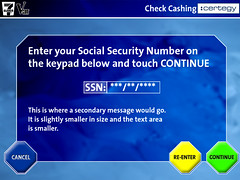
7-Eleven Check Cashing Kiosk7-Eleven Inc. has deployed several financial services kiosks as a competitive product to InnoVentry's RPM Cash Management Machine. The kiosk, called VCOM (“Virtual Commerce” Machine), provides “unbanked” customers (people without bank accounts) the ability to perform common financial service transactions at a single location on one device. Customers can perform ATM transactions, purchase money orders, perform wire transfers, pay bills, and more. |